

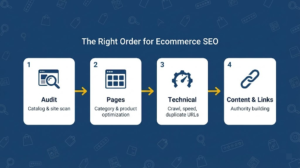
Most SEO advice for online stores starts in the wrong place. It often focuses on content or backlinks before making sure the product and category pages that generate sales are properly set up to rank. This is what ecommerce SEO services actually cover when an agency does the work in the right order, what to expect at each stage, and the warning signs to look for before signing a contract.
Which Pages Matter Most for Ecommerce SEO?
Category and product pages matter more than the homepage or the blog for most stores, because that’s where buyer-ready searches actually land and convert.
Why Category Pages Matter More Than Your Homepage for SEO
If someone searching for “running shoes,” it usually means they are still exploring their options and may purchase later. On the other hand, a search like “waterproof trail running shoes size 10” shows much clearer buying intent. The person already knows what they are looking for and is much closer to making a purchase.
Your homepage can target broader search terms, while your subcategory and collection pages should focus on more specific searches. These pages can help you reach customers who already knows what they want, and they are closer to making a buying decision.
Most collection pages make the same mistake by simply listing their products. This might work for buyers who already know exactly what they want, but many shoppers are still trying to figure out. They may be comparing different options, looking for better materials, checking sizes, or trying to understand which product would suit them best.
That is one of the reasons buyers often take longer to make a decision. Adding a short introduction, a few buying tips, a size chart, and answers to common questions can make the process much easier for them. It also means they do not have to open multiple tabs just to find basic information about the products.
When buyers can find most of the answers they need on the same page, they are more likely to stay, explore the products, and make a decision instead of leaving the website to search elsewhere.
There is also an SEO benefit. There is also an SEO benefit. Search engines do not see a product page the same way customers do. They rely on the content around the products to understand what the page is about. Adding useful and relevant information gives search engines more context, which can also help the collection page appear for relevant searches.
These details may seem minor, but they can be the difference between a collection page that gets found and one that barely gets any visibility.
Do Individual Product Pages Bring in SEO Traffic?
A specific size, colour, or model might only pull ten or twenty searches a month on its own, nothing to build a strategy around in isolation. One product bringing in ten searches a month doesn’t sound impressive. A few hundred products doing the same thing is a different story. Those smaller, highly specific searches can add up to a meaningful source of organic revenue.
A common mistake is using the manufacturer’s product description on every page. When dozens of products repeat the same copy, search engines may see the pages as too similar. It also makes it harder for shoppers to understand the difference between one product and another.
Each product page should include useful and original information, such as clear specifications, customer reviews, guarantees, and delivery details of the product. What really matters is whether the page gives someone enough confidence to go ahead and buy. Just adding more words to a template won’t fix that.
Does Blog Content Actually Help Ecommerce SEO?
It can, but only when the content helps move someone closer to a purchase.
A post titled “The History of Athletic Footwear Manufacturing” might attract some traffic, but it is unlikely to send many people to a product or collection page. That is the difference between content that simply looks informative and content that supports sales.
Before publishing a blog post, ask two simple questions: Would a real customer search for this? And does the article guide them towards a page where they can buy something?
Comparison articles, buying guides, and use-case content often work well because they reach shoppers while they are still deciding. A post such as “X vs. Y” or “Best Gifts for a New Runner” can answer their questions and then guide them to the right collection or product page.
Why Internal Linking Matters for Ecommerce SEO
Internal links help your category, product, and content pages work together instead of competing as separate parts of the website.
Ideally, authority should flow from the homepage to collection pages, then to product pages and supporting content. Most online stores do not build this structure properly. Their navigation may link to collections, but blog posts and product pages are often left disconnected.
A blog post may be published without any other page linking to it. It may also fail to guide readers towards a relevant collection or product. When a page has no internal links pointing to it, search engines may struggle to find it, understand its importance, or rank it properly.
Improving internal links usually costs very little, but it can have a big impact. It helps search engines find important pages, allows authority to flow through the website, and guides shoppers towards products they may want to buy.
Technical SEO and website authority support everything else. Duplicate URLs created by filters and product variants, unnecessary pages being indexed, and broken redirects can quietly weaken the work being done across the rest of the site.
Backlinks also matter, but they are most valuable when they point to pages that are already useful and ready to convert. A backlink cannot fix a weak collection page. It may simply send more visitors to a page that gives them no reason to stay.
What Does an Ecommerce SEO Agency Actually Do?
A good ecommerce SEO agency should handle five key areas: a detailed review of your product catalogue, clear keyword mapping, product pages that help shoppers make confident decisions, technical improvements that work across the entire store, and reporting that tracks conversions and revenue instead of focusing only on rankings.
What Should an Ecommerce SEO Audit Actually Check?
A shirt available in five colours might show up under two different URLs, the main product page and a second one generated by a filtered collection view. Google sees two competing pages for what is really one product, and that competition can quietly weaken both. A proper audit catches problems like this and fixes them with canonical tags, which tell search engines which version should be treated as the primary page. A report that only flags slow page speed and never touches this kind of duplication isn’t really an ecommerce audit, it’s a generic checklist with an ecommerce store attached.
At Zimble, this is the first of four stages in every engagement: audit and opportunity analysis, then strategy and keyword mapping, then implementation, then ongoing monitoring. Starting here means the strategy gets built around the website’s real problems and opportunities instead of applying the same template to every business.
How Should Keywords Be Mapped Across an Ecommerce Site?
A homepage trying to rank for “waterproof size 10 trail shoes” is targeting a search that’s far too specific for it. At the same time, a product page going after “running shoes” is aiming at a search that’s much too broad. Category pages are better suited to broad terms, while subcategories and product pages can take on the more specific searches. When those roles get mixed up, pages start fighting over keywords that don’t really belong to them.
At Zimble, we look at the search first and then decide which page should target it. That way, a shopper looking for something specific has a page that actually matches what they’re trying to find.
How Do You Optimize Product Pages for SEO and Conversions?
Start by making it easy for customers to see what makes each product different. Explain the differences between similar options, include useful specifications, and add trust signals such as reviews, guarantees, delivery details, and return information.
A label like “Blue, Size M” is not enough when several products look almost same. Customers need clear reasons to choose one option over another. Search engines also need enough unique information to understand what each product page is about.
A product page can rank well and still fail to generate sales. SEO only becomes valuable when the page also gives shoppers the information and confidence they need to buy.
What Technical SEO Issues Matter Most for Large Catalogs?
A store with a few hundred products can create a lot more URLs than you might expect. Add filters for colour, size, and price, and every combination can produce another URL for search engines to crawl. Most of these aren’t separate products or pages worth ranking, but they can still add up quickly as the catalogue grows.
Some of the most important areas include:
-
Canonical tags for duplicate product variants – these help search engines understand which version of a page should rank, so authority is not divided across several similar URLs
-
Control over filtered and sorted URLs – filters for colour, size, price, or sorting can create a large number of unnecessary pages; if search engines crawl and index all of them, they may spend less time on the pages that actually matter
-
A clear plan for discontinued or out-of-stock products – deleting a product page can waste the rankings and backlinks it has already gained; in many cases, it’s better to redirect the page to a relevant alternative or keep it live with a clear stock update or “notify me” option
-
Schema markup – this helps search engines display useful details such as price, availability, and ratings directly in search results; without it, your listing may look less useful than a competitor’s
This work is not always easy to present in a client update, but it plays an important role in how well a large ecommerce site performs. It is also one of the areas less experienced agencies often overlook because the problems are not immediately visible.
What Should Ecommerce SEO Reporting Include?
A category page can rank on page one and still bring in very little business. Maybe the people finding it aren’t ready to buy, or the traffic isn’t reaching the right products. That’s why looking at rankings alone doesn’t tell you much about whether the SEO is actually working.
A good report should clearly explain how search traffic turns into sales. It should highlight through which pages visitor are coming, whether those visitors are actually converting into customers, and how much revenue that traffic is generating.
What Are the Warning Signs of a Bad Ecommerce SEO Agency?
One of the clearest warning signs is an agency quoting a fixed monthly fee before asking about your product count, ecommerce platform, or catalogue structure. That usually means you are being offered a standard package designed for a small website, not a growing online store.
Other warning signs include guaranteed rankings, promises of first-page results within 30 days, and unclear answers about who owns your website data, analytics, and accounts after the contract ends.
No responsible agency can guarantee a specific ranking. Search performance depends on competition, website quality, algorithm updates, and several other factors that no agency can fully control.
A reliable agency should clearly explain how it works, how results will be measured, and who will retain ownership of the website data and accounts.
Before recommending a package, it should also ask about your number of products, platform, product variants, website structure, and how the catalogue is managed. If every store receives the same plan without these questions being asked, the strategy is unlikely to be detailed enough for an ecommerce website with hundreds or thousands of changing product pages.
What Should You Do Based on Your Current SEO Situation?
The right first step depends on whether you’re starting from paid ads only, questioning an existing agency, or comparing new ones.
What If You’re Already Running Paid Ads With No SEO Strategy?
This is a normal, common starting point.
Your paid campaigns have already shown which keywords generate sales because you can see the results directly in your ad account. Instead of beginning SEO with a completely new keyword list, the agency can use this existing data to identify the searches that already convert.
The next step is to assign those proven keywords to the right category, collection, and product pages. This allows your website to start attracting some of the demand you are currently paying for with every click.
Results may come more quickly in this situation because the advertising data has already helped answer an important question: which searches actually lead to sales?
How Do You Know If Your Ecommerce SEO Agency Is Actually Working?
Start by asking what the agency is tracking. If the reports only focus on traffic and keyword rankings, you are not seeing the full picture.
The technical work and content updates may be performing well, but the reporting may not be connected to sales and revenue.
Ask the agency to show which pages are bringing in traffic, which keywords are driving those visits, how many visitors are converting, and how much revenue organic search is generating.
What Should You Look For When Comparing Ecommerce SEO Agencies?
Whether the proposal discusses your catalog and platform before it discusses a content calendar.
An ecommerce SEO proposal should mention your catalog size, ecommerce platform, website structure, duplicate product variants, filtered URLs, and indexing issues before it starts discussing blog schedules. If the proposal leads with a content calendar but says nothing about how your store is built, ask the agency how it plans to handle the technical and structural side of the website. The answer will often tell you whether the proposal was created for your business or copied from a standard template.
What Results Has Zimble Delivered for Ecommerce Clients?
THE BEAUTIFUL Co., a UK jewelry brand, saw website traffic double and sales grow from around £5,000 to £65,000 over an 18-month engagement.
THE BEAUTIFUL Co. came to us with paid ads already bringing in sales, while organic traffic was barely getting started. We focused on searches with clear buying intent and connected those keywords to the collection and product pages where they made the most sense. We also streamlined the header and footer to make key pages easier to find and navigate.
At Zimble, our leadership team remains actively involved throughout the engagement rather than stepping away once the contract is signed.
Paid ads and SEO can work alongside each other. Ads can bring in traffic and sales quickly, but that traffic usually drops when the budget stops. SEO takes more time to build, but the traffic can continue long after the initial work is done. For a growing ecommerce business, using both gives you a stronger mix than relying entirely on either one.
Frequently Asked Questions
Should I Fix Technical SEO or Start With Content?
In most cases, technical SEO should come first.
Publishing new content or building backlinks will not do much if your website has duplicate URLs, indexing issues, or too many unnecessary pages being crawled.
Fix the technical foundation first. Once search engines can properly access, understand, and index the right pages, your content and link-building efforts are far more likely to deliver results.
My traffic is growing, but sales are not. What does that mean?
It often means the website is attracting visitors who are not ready to buy. This can happen when the SEO strategy focuses on broad or informational keywords rather than searches with buying intent. Ask which pages are receiving more traffic and which search terms are bringing people to those pages.
Should I delete seasonal collection pages after the season ends?
Usually not, especially if you plan to use the collection again next year. Keeping the same URL allows the page to retain any rankings, backlinks, and authority it has already earned. You can update the content, remove it from the main navigation during the off-season, or clearly state when the collection will return.
What should I do with an out of stock product page?
It depends on whether the product will be restocked again. If it is temporarily out of stock, keep the page live and add a clear stock message or a “notify me” option. If the product has been permanently discontinued, redirect the page to the closest relevant option. This helps preserve any backlinks and rankings the original page has already earned.
Should I rewrite manufacturer product descriptions?
Yes, at least the most important sections. Using the same manufacturer description that appears on several other websites gives search engines little reason to choose your page over a competitor’s. Start by rewriting the introduction in your own voice, then add specifications, sizing information, FAQs, delivery details, guarantees, and customer reviews.
Do Customer Reviews Help SEO?
Yes, but their biggest benefit is building trust with shoppers.
Reviews add fresh content to product pages, answer common questions, and show that other customers have bought and used the product. When review schema is set up correctly, star ratings may also appear in search results, helping your listing stand out.
How Many Collection Pages Should My Store Have?
Focus on creating useful collection pages instead of creating as many as possible.
A smaller number of clear, well-organized, and properly optimized collections will usually perform better than dozens of thin pages targeting similar keywords. Each collection should have a clear purpose and make it easier for shoppers to find the right products.
How is ecommerce SEO different from SEO for a service business?
Scale and structure. A service business may have a small number of pages focused on generating enquiries. An ecommerce website may have hundreds or thousands of category, collection, filter, and product pages that need to rank and convert at the same time, facing ongoing challenges like duplicate content and index bloat that smaller service sites rarely deal with.
How long does ecommerce SEO take to show results?
Most websites begin seeing noticeable improvements within three to six months, depending on site condition, industry, and competition. A site with serious technical issues may need part of that time to fix crawling and indexing problems before ranking improvements become visible. That work is not wasted time.
Can an agency guarantee first-page rankings?
No. Rankings depend on competition, search engine updates, website quality, user behaviour, and many other factors no agency can fully control. At Zimble, we do not guarantee specific positions.
Is SEO Worth Adding if I Already Run Paid Ads?
Yes. Paid ads can bring traffic quickly, but that traffic usually drops once the campaign ends or the budget is paused.
SEO takes longer to build, but it can keep bringing people to your website without charging you for every click. The two channels can also support each other. Paid campaign data shows which keywords lead to sales, while SEO helps your website rank for those same searches over time.
When Should I Start Building Backlinks?
Start building backlinks once your category and product pages are useful, well optimized, and ready to convert visitors into customers.
Sending links to a weak, confusing, or poorly structured page wastes much of their value. Build strong pages first, then use relevant backlinks to improve their authority and visibility in search results.
